|
The Out-of-Date Eatwell Guide and the Demonisation of Saturated Fat The Story of the UK Government's Eatwell Guide and its dogmatic stance on saturated fat is as shocking as it is fascinating. Nick Crawford from Arden Forest Wellness tells their story. |
|
The Heart Attack Our story starts in 1950's with an American physiologist called Ancel Keys and President Dwight D. Eisenhower. Keys had been wrestling with the counter-intuitive observation that American business executives, presumably among the best-fed people, had high rates of heart disease, while in post-war Europe the rates had decreased sharply in the wake of reduced food supplies and rationing. His research at the University of Minnesota led him to hypothesise that this was due to the relatively large amounts of saturated fats they were consuming which he called his 'diet-lipid-heart disease hypothesis'. 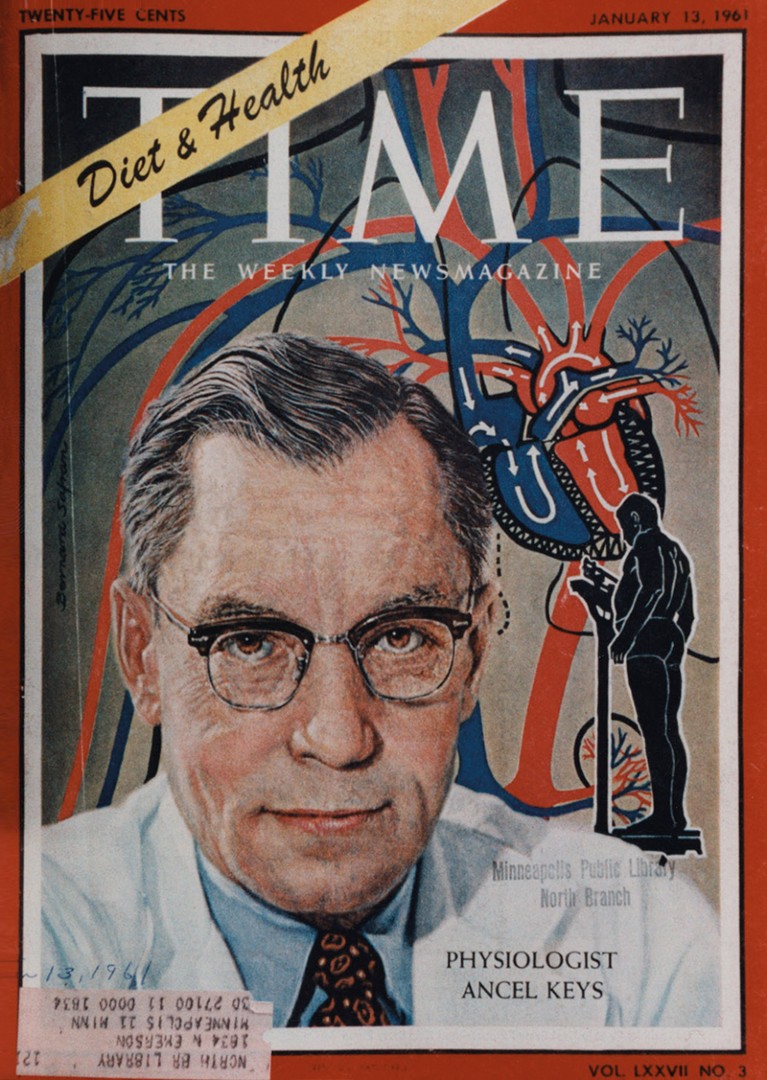 Ancel Keys on the cover of Time Magazine on January 13, 1961 |
|
Whilst holidaying in Colorado in September 1955, Eisenhower suffered and major heart attack which gave the whole USA a rude awakening to the fact that heart disease among middle-aged men was reaching epidemic proportions. Something had to be done. This national need motivated Eisenhower's personal physician, Dr. Paul Dudley White, to openly discussed the role of diet and cholesterol and saturated fats with the press, setting the stage for White's friend, Keys, to come to the rescue.
.  Dwight D Eisenhower 34th president of the United States from 1953 to 1961 |
|
Crisco Back in 1920's USA a small organisation had been founded with White as a founder member. It was the American Heart Association (AHA) and now was its time to spring into action. However, the AHA had a significant conflict of interest, since in 1948, it had received $1.7 million, or about $24 million in today's dollars, from Procter & Gamble (P&G), the makers of Crisco oil a polyunsaturated vegetable oil. It was the perfect storm with Keys and White pushing their unfounded 'diet-lipid-heart disease hypothesis' demonising saturated fat and with P&G wishing to promote their polyunsaturated vegetable oil and holding the AHA virtually to ransom. Oh, dear! 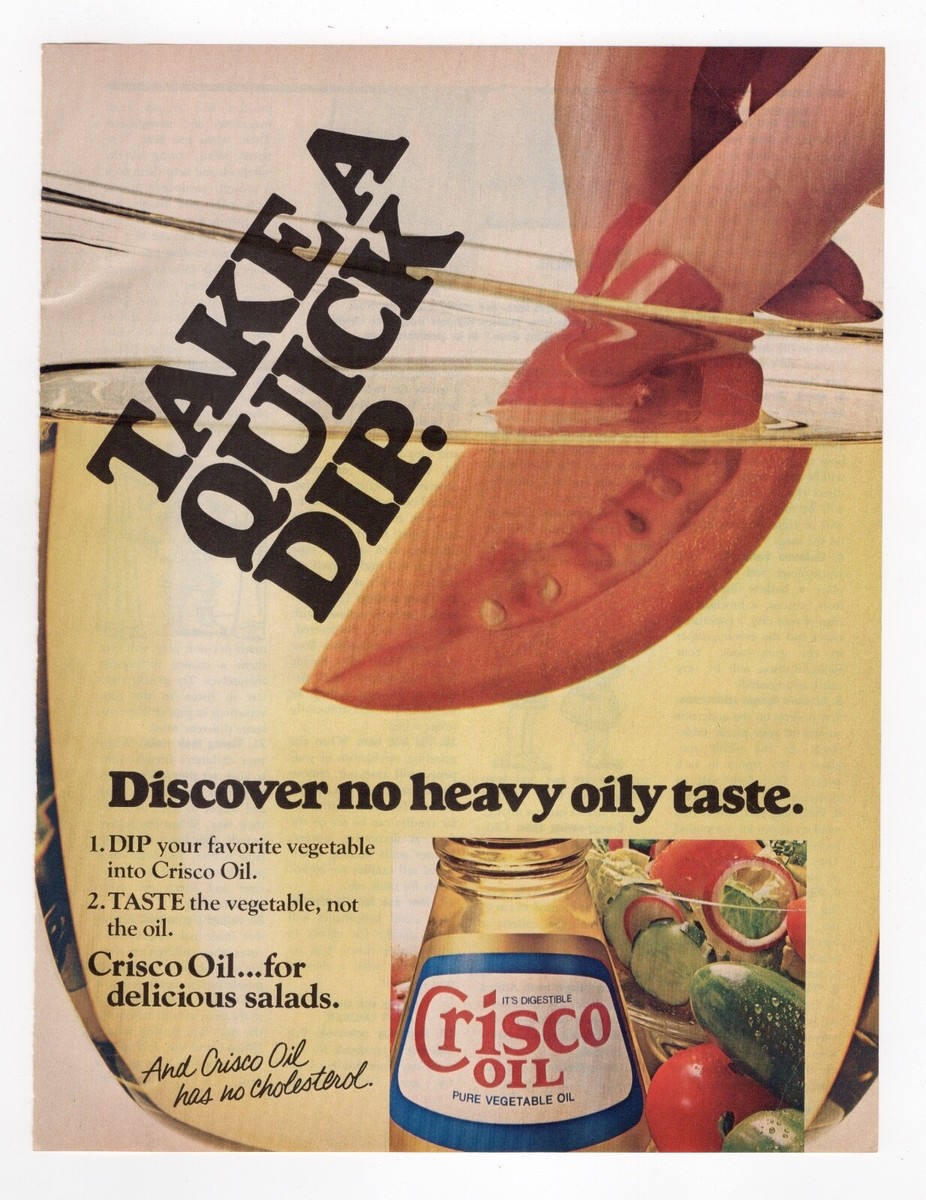 Crisco Oil Advert |
|
The 7 Countries Study As his final proof of the 'diet-lipid-heart disease hypothesis' Keys launched one of the largest ever lifestyle studies using 13,00 men from seven countries which is known as 'The Seven Counties Study'. Starting in 1958, these men were regularly monitored for their diet, cholesterol levels and their mortality. The first major release of findings came after twenty years; the results were clear (as mud), there was a direct correlation between the consumption of saturated fat, high cholesterol levels and coronary heart disease (CHD) risk. Slam dunk, the World was sold on saturated fats being the enemy. I won't go into the theory that Keys cherry picked his countries such that the study would back his hypothesis as there's a more fundamental flaw: We now know that a direct relationship between high cholesterol levels (LDL) and CHD is physiologically and epidemiologically untrue. The upshot of all this, however, was that the so-called connection between saturated fat intake and CHD became one of the dogmas of a 'healthy' diet the World over; the UK included. We now know that it was (and still is) the carbohydrates (starch and sugar) in the food the subjects of The 7 Countries Study were eating that was driving the CHD and not the saturated fat - it was, as they say, a case of mistaken identity. Science trivia: It is more metabolically efficient for the body to breakdown saturated fat than unsaturated or polyunsaturated fats. This is due to the process of beta oxidation in which the double bonds in unsaturated or polyunsaturated fats need to unbent by special enzymes, a process which needs not be done for saturated fats. 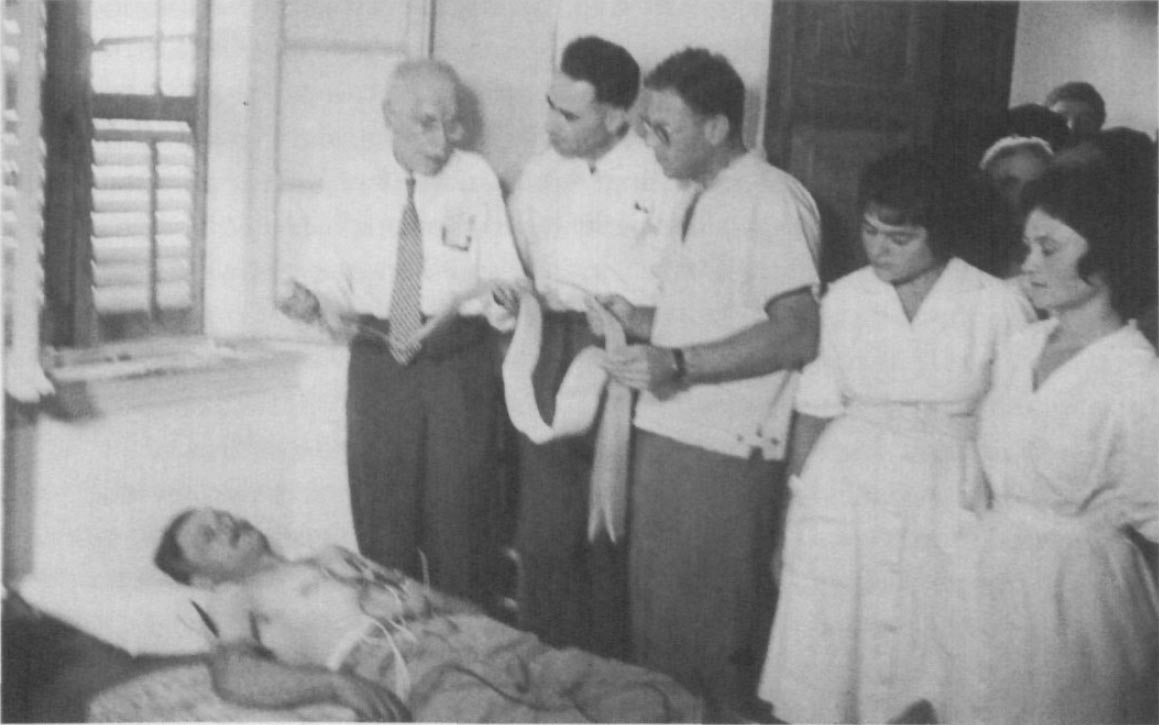 Paul Dudley White, Christ Aravanis, Ivan Mohacek reading ECC's, Crete, 1960 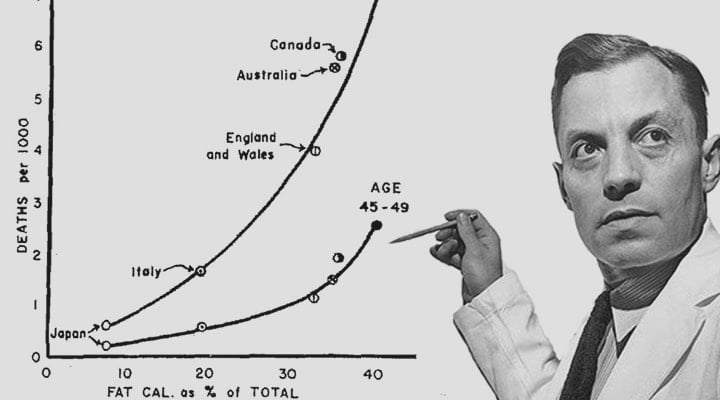 Acel Keys and his cherry-picked data |
|
The Eatwell Guide Winding the clocks forward to the late 1980's, despite the dire warning of saturated fats and in the face of still rising heart disease and type 2 diabetes, the UK Government was coming under pressure to give further guidance on diet. A government department aptly called COMA (Committee on Medical Aspects of Food and Nutrition Policy) was tasked to produce this guidance. Based on existing work: Recommended Daily Intakes (RDI) 1969 and Recommended Daily Amounts (RDA) 1979, together with their hunches and best guesses, the 'Dietary Reference Values for Food Energy and Nutrients for the United Kingdom' was published in 1991 which on pages xx and xi gave a run down on what they believed the average person's diet should look like. "Thank you very much," said the UK Government "Well done, good work." And the UK macro-nutrient guidelines where born - not out of any science, just conjecture, what people were eating in the late 1980's and the way the wind was blowing. The guidelines have evolved from the 'Balance of Good Health' in 1994, to the Eatwell Plate of 2007 and through to the Eatwell Guide that we use today and all have the same breakdown of approximately 47% energy from carbohydrates, 33% from fats, 15% from protein and 5% from other sources like alcohol. Just a quick note about the 5-A-Day recommendation. This is a good one because once again it's commercial gain over real science. It started in California in 1988 as a joint public health and agricultural project created by state health director Ken Kizer to promote the state's homegrown produce. Because the slogan was so catchy, the World Health Organization picked it up in 1991 and we in the UK followed suit in 2003. Today's science tells us to read it as 5-A-Day Leafy Greens. 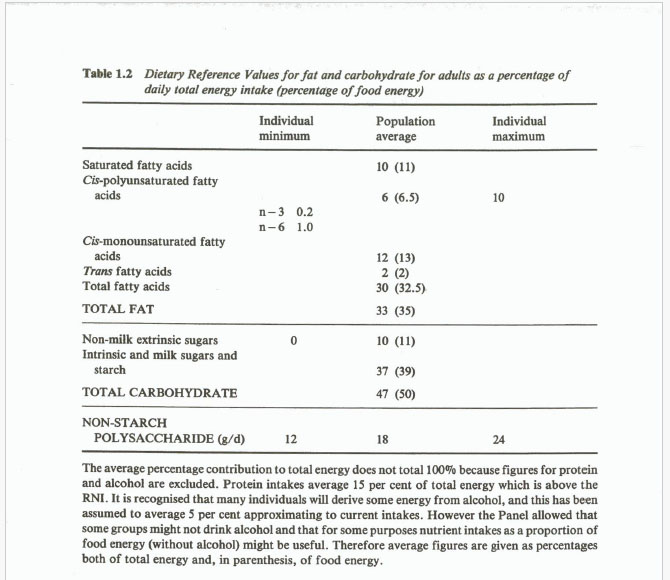 Dietary Reference Values for Food Energy and Nutrients for the United Kingdom 1991 page xx (page 20, not kisses)  NHS PR1946 Annex 1 - Service Specification for NHS prediabetes courses. |
|
A Good Debunking But, in the four decades since the birth of the NHS's Eatwell trilogy and the dreaming up of 5-A-Day slogan and half a century since the first results of The 7 Countries Study, a lot of science and research has been conducted. We know an awful lot more about physiology and nutrition and what a healthy lifestyle really looks like. In the last half century, the Ancel Keys' link between saturated fat and heart disease has largely been debunked by the scientific community. His study was found to have been flawed in several important aspects, and our understanding of fats and cholesterol has come on leaps and bounds. We now understand that it's not so much LDL levels that are the indicators of risk, but such esoteric-sounding things like Apo B and Lp(a) about which Keys knew nothing as they were only discovered in the late 1960's and early 1970's. But even Apo B and Lp(a) aren't the full story, it ultimately all boils down to glucose intake and the resulting insulin levels pounding your body over the years into an ever-increasing blood vessel-damaging inflammatory response. As far as carbohydrates (both starch and sugar) are concerned, we now know it is they that are largely responsible for driving chronic diseases such as cancer, CHD, type 2 diabetes and Alzheimer's. It's all the starchy carbs (bread, cereals, potatoes, rice, pasta etc) we eat that's keeping us overweight. We also know that vitamin-packed fruit, once thought to be so healthy, has had to suffer a major relegation with equally vitamin-packed leafy greens having been promoted. That said, and for the avoidance of doubt, fruit is still in a much higher league than sugar-filled fizzy drinks, cakes and biscuits. Science trivia: If someone asked you what the essential macronutrients were, would you say, "Carbs, protein and fat"? It might surprise you to know that carbs are not an essential nutrient - we can live without them. We can't live without protein and fat nor the micronutrients of vitamins and minerals. 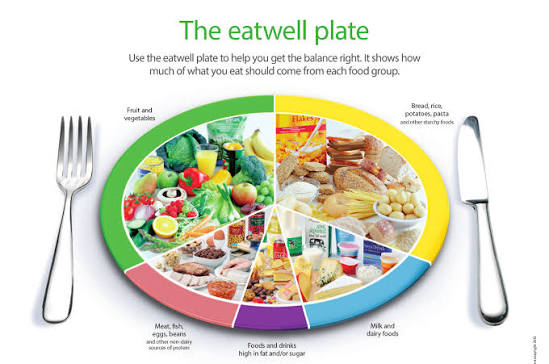 The Eatwell Plate introduced to the UK in September 2007 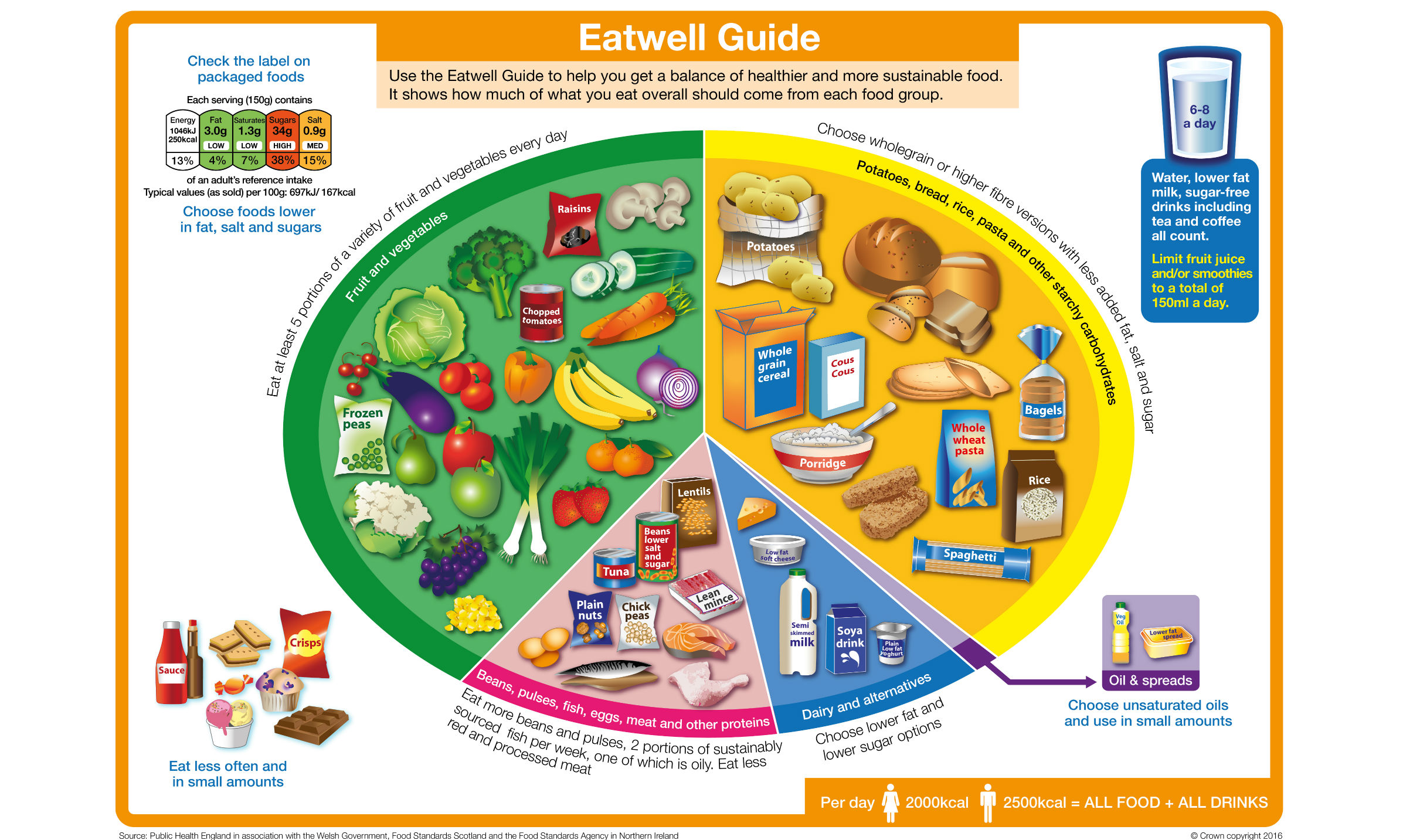 The Eatwell Guide introduced to the UK on 17 March 2016 |
|
|